The Big Takeaway: As AI delivers intelligence faster and cheaper, we need a workforce with good judgement.
Drupal is a powerful, API-first, open-source CMS framework that runs many government agency and higher education websites. As a result, many of BIT’s clients use Drupal. In fact, I first met BIT when I worked at an agency building Drupal websites for cities, and BIT checked our deliverables for WCAG compliance.
Drupal is a community of developers and digital practitioners with a longstanding commitment to ship public-facing and administrative themes that meet WCAG AA out of the box. Last year, I was thrilled when BIT’s Executive Director and my boss, Mike Hess, met Dries Buytaert, the developer who created Drupal in 2001 and still leads the project today. When Mike was invited to keynote DrupalCamp Colorado 2026 (DCCO) in Denver, we both gave an enthusiastic “Yes!”
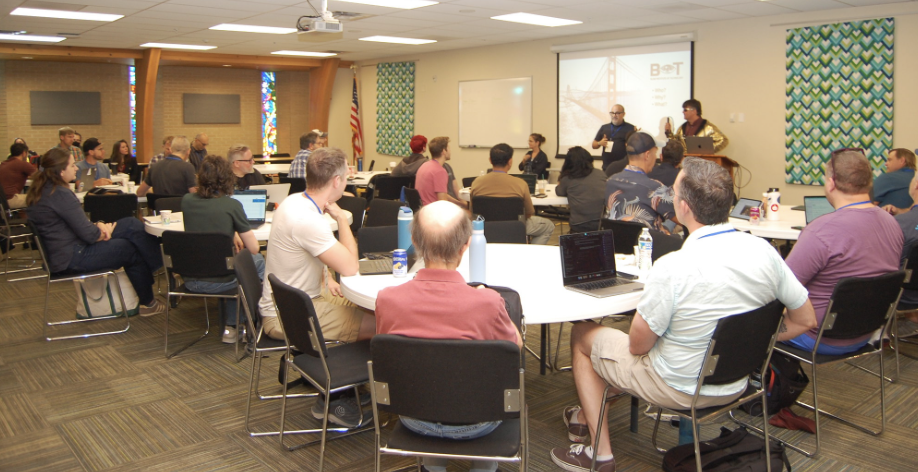
Held every year since 2007, DCCO is the longest continually running DrupalCamp in the world. I’ve been to nearly every one since moving to Colorado in 2013. It was Mike’s first keynote at a Drupal event, yet many of the people in the room already knew him through his work and BIT’s reputation.
A Thoughtful Talk About AI That Resonated
This year, DCCO had a keynote both days of the event. The other keynote was from Seth Brown, the CEO of Lullabot, a premier development agency that’s been building Drupal applications and websites since 2006.
Seth’s keynote, titled “The No Fire, No Hire Stalemate: What AI Is Actually Doing to Agency Jobs” was a session about how AI has changed digital agencies, with thoughts on what’s to come. He talked about how AI has already massively increased Lullabot’s value to clients, asked tough questions, and shared a story from his early career that stuck with me.
AI’s Impact on Early Career Growth
Seth talked about his time as an entry-level writer for the Colorado College communications office. His editor marked up his articles with thoughtful, handwritten notes in the marginalia, mentored him, and gave him advice he still uses as the CEO of a digital agency.
It’s no surprise that mentoring and apprenticeship were keys to Seth’s success. BIT’s entire Academy and apprenticeship program are built around mentorship and sustained professional development. Today, BIT apprentices include two recent computer science graduates starting their first professional roles.
Seth asked why his first job existed at all. Not generosity. The press releases had to get written, and the training came along for free. For 30 years, agencies hired juniors for their output, and producing it was how they learned. AI just made that output cheap. If routine work no longer pays for training, training has to be intentional. That’s what a structured apprenticeship is.
Juniors learn from senior-level feedback, including feedback that they don’t agree with, or fully understand at that moment. Seth imagined getting the same corrections back from a machine instead of from a mentor. He might have quit, or worse, accepted the corrections without checking them.
He asked the audience why hire entry level folks when we can now get similar output from a $240 annual subscription to a frontier LLM. Short-term, this is not economically rational. But, if we don’t, we risk draining the talent pool we all draw from.
Apprenticeships are a Smart Investment
In a structured apprenticeship program, an apprentice is hired into a paid role from day one, then builds skills through on-the-job training under the close supervision of an experienced journeyworker.
Apprenticeships are good for the bottom line. A Department of Labor white paper found that the most rigorous estimates put employer ROI between 40% and 90%, which works out to $1.40 to $1.90 back for every $1 invested.
Employee retention is where the investment compounds. More than 90% of apprentices remain employed after completing their program. This is why BIT formalized our Academy, certification, and apprenticeship programs around these principles.
AI Underscores the Importance of Apprenticeships
It takes years to shape good judgment. When Colorado College hired Seth as an entry-level writer, they were giving someone the tools to eventually become a successful CEO. Seth got a laugh from a room full of seasoned Drupal experts by quoting Niels Bohr, “An expert is a person who has made all the mistakes that can be made in a very narrow field.”
As we hand over low-level tasks to AI, someone still has to decide whether AI-generated code or content is good enough to ship. An organization investing in apprentices today creates professionals who can make those decisions in the future.
Mentorship is also Professional Development
It’s important to not overlook a key detail in Seth’s personal story: the Colorado College communications office was investing in its editors, too.
Hiring entry-level people sharpens senior-level skills. It’s central to the open source ethos of the Drupal community that sharing what you know makes you get better at what you do. Investing in apprentices is an investment into leadership — now and in the future.
Thanks for a great talk, Seth!
Thank you, DrupalCamp Colorado!
Thank you to the DCCO organizers for inviting Mike to keynote and for bringing the Colorado Drupal community together! We’re grateful to be part of a community that treats accessibility as a shared responsibility. Can’t wait for the next camp!
Thank you to Dries Buytaert and everyone in the Drupal community for bringing together these local communities of open source experts. Wherever you are in the world, there’s likely a Drupal Camp near you.
And, thank you to the City of Denver, and State of Colorado for investing in tech communities. BIT’s hometown continues as a huge part of our story and success.
Build Your Team
If your organization wants to cultivate digital accessibility, Salesforce, or digital project management talent, learn what it looks like to become a BIT Employer Partner. Schedule a call.